About Freyja
Freyja is a major goddess in Norse mythology and a central figure in the Asatru faith. She is known as the goddess of love, beauty, fertility, and war, and she is associated with the Vanir, a group of gods and goddesses who were known for their wisdom and magical powers.
Freyja is often depicted as a beautiful woman with long, golden hair and a chariot drawn by cats. She is associated with the earth and its fertility, and is said to have the power to grant blessings and abundance. As the goddess of love and beauty, Freyja is also associated with passion and desire, and is said to be able to grant love and happiness to those who seek her favor. She is sometimes referred to as the “Lady of the Vanir,” and is often depicted as a leader and protector of her people.
Freyja is also a powerful warrior goddess and is associated with death and the afterlife. According to Norse mythology, she has a cloak of falcon feathers that allows her to shape-shift into a falcon and fly through the skies. She is also said to have a chariot that is drawn by two cats, and she is sometimes depicted riding into battle with a sword in hand. In addition to her warrior aspects, Freyja is also associated with the wild hunt, a ghostly procession of the dead that is said to ride through the skies during the winter months.
In Asatru, Freyja is revered as a powerful and influential goddess. She is often invoked for blessings of fertility, love, and abundance, and is also honored for her strength and courage as a warrior goddess. Many Asatruar make offerings to Freyja and ask for her guidance and protection in times of need.
Freyja is a complex and multifaceted goddess who represents many different aspects of life and the human experience. She is a source of strength and inspiration for those who follow the Asatru faith, and is an important figure in Norse mythology and culture.
In addition to her roles as a goddess of love, beauty, fertility, and war, Freyja is also associated with many other aspects of life and the human experience. She is the goddess of sex and sexuality, and is said to be able to grant pleasure and ecstasy to those who seek her favor.
Freyja is also connected to many other aspects of Norse mythology and culture. She is the sister of the god Freyr, who is the god of fertility and prosperity, and the two are often depicted together.
Freyja is also said to possess a magical necklace called the Brísingamen, which is said to grant the wearer great beauty and power. The goddess is sometimes depicted as wearing this necklace, which is said to have been crafted by the dwarves.
Freyja is a beloved and revered figure in Norse mythology and Asatru, and is often invoked for blessings and guidance. She is a powerful and influential goddess who represents many different aspects of life and the human experience, and is an important figure in Norse mythology and culture.
Freyja Appearance Poem 2
Freyja, fair goddess of love and war
With golden hair and delicate features
Her graceful and elegant form
Is adorned in a flowing gown of gold
Her hair cascades down her shoulders
In long, flowing locks of shining gold
A cloak or mantle adorns her form
With intricate designs and patterns
A necklace of gold encircles her neck
And a cup or vessel is held in her hand
Symbols of her connection to abundance and fertility
And her role as the goddess of love and war
Her pet cats and chariot
Are at her side, protectors and companions
Symbols of her connection to the natural world
And her power over the animals
A crown upon her head
Signifies her status as a goddess and ruler
Surrounded by the beauty of nature
Freyja stands, a powerful and majestic figure
Love, beauty, fertility, and war
All are represented in her being
Freyja, goddess of the Norse pantheon
A stunning and graceful embodiment of power.
Her presence brings peace and abundance
To all who behold her beauty
Freyja, fair goddess of love and war
A powerful and majestic force in Norse mythology.
Freyja Appearance Poem
Freyja, fair goddess of love and war
With golden hair and graceful form
She stands tall, in a meadow of flowers
Adorned in gold, a cloak of patterns
Her long locks flow down her shoulders
And a necklace of gold encircles her neck
In her hand, a cup or vessel
Symbols of abundance and fertility
Her faithful cats and chariot
Are at her side, protectors and companions
A crown upon her head, she reigns
Freyja, goddess of Norse mythology
Beauty, love, and war combine
In this powerful and majestic figure
Freyja, fair goddess of the Norse
A graceful embodiment of power.
Gods and Goddesses Connected With the Vanir
The Vanir are a group of gods and goddesses in Norse mythology who are associated with fertility, abundance, and prosperity. Some of the most well-known Vanir deities include Freya, Njord, and Freyr.
Freya is the goddess of love, beauty, and fertility, and is often considered to be the most prominent of the Vanir deities. She is associated with the Vanic Virtues, and is said to be generous and open-hearted. She is also associated with magic and shapeshifting, and is sometimes called upon for protection and guidance.
Njord is the god of the sea, fishing, and sailing. He is associated with the Vanir because he is a god of abundance and prosperity, and is said to be generous and hospitable. He is often depicted as a wise and gentle deity, who helps those in need and brings good fortune to those who honor him.
Freyr is the god of fertility, crops, and wealth. He is often associated with the Vanir because he is a god of abundance and prosperity, and is said to be generous and hospitable. He is also associated with the Vanic Virtues, and is said to be a god of peace and harmony.
There are also several other Vanir deities who are less well-known but are still associated with the Vanir. These include Ullr, the god of hunting and archery; Gullveig, the goddess of magic and sorcery; and Snotra, the goddess of wisdom and prudence. These deities are associated with the Vanir because they embody the Vanic Virtues and are associated with fertility, abundance, and prosperity.
Poem About Vanaheim
In Vanaheim, the land of the Vanir,
Nature reigns supreme and wild.
The gods and goddesses live in harmony,
With the earth, the sky, and the sea.
Here, the fields are green and lush,
Fruit trees bend with heavy boughs.
The air is sweet and the water pure,
And the creatures of the land live without fear.
In Vanaheim, there is no need for walls,
For the Vanir are wise and powerful.
They command the forces of nature,
And keep their land safe and secure.
Here, life is good and joyous,
And the Vanic Virtues are held dear.
Generosity, abundance, and fertility,
Are the guiding principles of this peaceful realm.
So if you seek a land of beauty and bounty,
Where nature is revered and harmony reigns,
Come to Vanaheim, and you will find,
A place of peace and prosperity, where all are welcome.
About Vanaheim
In Norse mythology, Vanaheim is the home of the Vanir, a group of fertility gods and goddesses. The Vanir are often contrasted with the Aesir, another group of gods who are associated with war and death. Vanaheim is described as a peaceful and fertile land, where the Vanir live in harmony with nature. Unlike the realm of the Aesir, which is known as Asgard, Vanaheim is not described as being protected by walls or fortifications. Instead, the Vanir are said to rely on their wisdom and magic to defend themselves and maintain the peace in their land.
Yggdrasil Poem
Hail Yggdrasil!
You are the world tree, the center of all things,
The axis mundi, the cosmic pillar,
Your roots reach deep into the underworld,
Your branches stretch high into the heavens.
You are the link between the nine worlds,
The home of the Norns, the fates of the gods,
You are the source of all knowledge,
The wellspring of wisdom and understanding.
You are the guardian of the gods,
The protector of the world,
You stand tall and strong,
A beacon of hope and light in the darkness.
Hail Yggdrasil, the mighty tree of life,
We offer you our reverence and praise,
For you are the source of all things,
And we are forever in your debt.
The Vanir Theory…
The Vanir Theory, this is something I very strongly believe in. I am someone that as a Heathen has a primary focus towards the Vanir, and I too have experienced from my own personal spiritual experiences that what this article is saying is accurate, and extremely important for understanding the Vanir.: http://waincraft.org/world-view/the-vanir-theory/
The ancient goddess Nehalennia
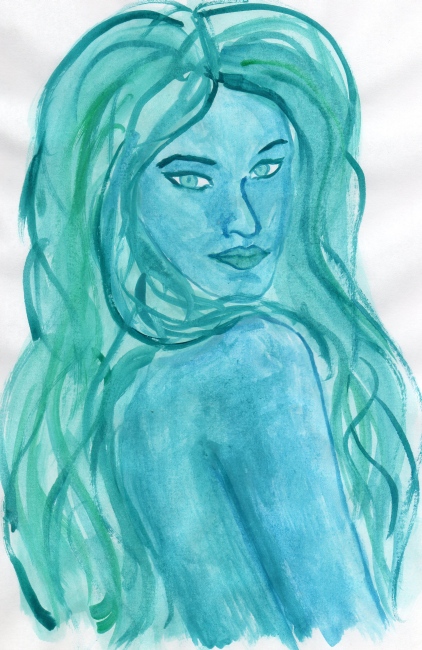 Nehalennia is a very ancient Vanic goddess. She is goddess of the ocean. She is related to hounds, trade, the sea, ships, and the harvest of the sea itself. She rules over passage from one state to another, such as the transitions from living to death (or my theory is the other way around too), and any journeys by water. She is an ancestor goddess of Njord, Freyja, and Freya. Her nature seems to be calming, gentle and providing, yet wild and untamed, in many ways like the character of the sea itself. She is seen to have very water like appearance. Some see her as very beautiful, with wide bright young eyes like a young girls, a perfect and lean figure, and wearing a hound necklace, being topless and wearing a very tiny mini skirt, and wearing a fishing net as a shawl. Her color is a blue green like the sea. I feel her runic energy for sure is laguz in a big way! Alternate spellings of her name are Nehelennia, and Nehalenni.
Some consider her a goddess of the dead, but I feel that isn’t exactly correct. She isn’t a Goddess that comes to claim the dead, but more one that helps them to safely make their journey to that realm. She basically rules safe passage from one place to another (either places being earthly places or even places as in states of being as in travel from the world of the living to world of the dead). This is more of a protecting and nurturing thing. Not harsh like for example Hel can be at times. Basically the historical offerings to her that have been found, they seem to have found were ones given in thanks for sailors making safe passage. Travel in general is associated in movement from one realm to another. This is connected with the rune laguz. This seems to be her energies. She is very connected to the goddess and female mysteries of helping beings pass from one state to another. Since women are the ones who give birth they rule over this aiding of beings coming from one realm to the other. Birth is a transition from the spiritual realm to the physical realm, in the same way birth is a transition from the physical realm to the spiritual realm. What is interesting also about birth and about the womb is it is a realm filled with water. This is very connected to the mysteries of wells or caldrons in the Norse cosmology. There are three important wells, and it is considered that wyrd (the Norse concept of fate or karma) for all beings flows through these wells. It is of course water that flows through wells so it seems wyrd and water are very connected. Since Nehalennia is a goddess that can be seen as the personification of water itself, it only makes sense that she rules over this mystery of the passage of wyrd or the passage from one state to another or even journeys or movement in general. Another rune connected with this mystery is perthro, but perthro may be considered the captured state of the flow of water in a sudden given moment. Yet Nehalennia seems to be more the open oceans, waters freely flowing without restriction, thus she is more related to laguz, not really to the parts of this process connected to perthro. Perthro is more the well structure itself, the vagina, laguz is more the water contained in it. A vagina is of course a very wet comforting place. ;) These mysteries are very Vanic in nature, since the Vanir are connected to both sexuality and to water and ships.
The drawing I have of Nehalennia is made by Amarina and used with her permission.
More about Nehalennia:
Amarina’s experience of Nehalennia.
Another very good post Amarina wrote about her impressions of Nahalennia, and the Vanir as a whole.
Info based on spiritual experiences of Nehalennia on Amarina’s blog.
Info on Hehalennia from livius.org.
She is written about in Our Troth Volume 1, pages 394-395.
She is also in Exploring the Northern Tradition, page 118.
An invocation to Nehalennia:
Hail Nehalennia! Beautiful goddess of the hounds, trade, and the sea! Lost lady of the Vanir! Ancestor of Njord, Freyja, and Freyr!

Very insightful video on elves…
The elves and related being are a very important part of Heathenism. They represent a large variety of beings. The Norse term used for spiritual beings in general is wights.

This work is licensed under a Creative Commons Attribution-NonCommercial-ShareAlike 3.0 Unported License.

 Volmarr’s Tumblr
- View On WordPress
- The Personal Norse Pagan Path That I, Volmarr, Follow.
- The Heathen Third Path within Norse Paganism and modern Viking culture
- Unveiling the True Viking Mindset: Clearing Away Modern Political Shadows with Ancient Wisdom and Modern Science
- Sample of AI GMed Norse Saga Engine Combat 2
- Poetic Edda: Complete Master Works Edition
- Sample of AI GMed Norse Saga Engine Combat
- Sample AI Generated Dialogue Generated by Norse Saga Engine:
- The Loom is Spinning: Enter the Norse Saga Engine
- Wow I just translated the whole Poetic Edda from Old Norse into poetic English in 25 minutes using…
 Volmarr's Blog of Modernist Heathenism, Norse-Paganism, and Norse-Wicca