The Sacred Distinction of Inner and Outer Space: A Norse Pagan Reflection on Black Holes and the Wombs of the Mother Goddess
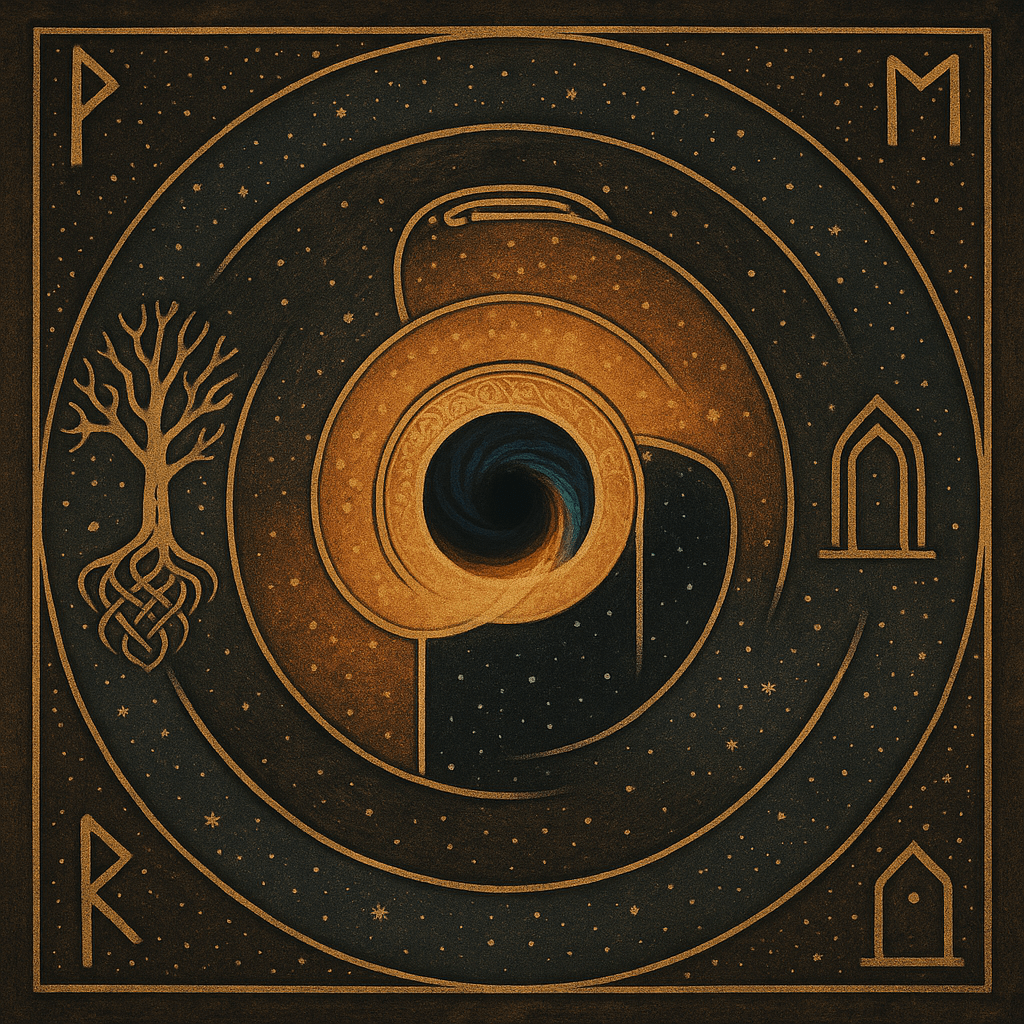
In my continued weaving of mysticism and emerging scientific ideas, I have come upon a new thread — a further mystical black hole theory. It speaks to the profound difference between what we perceive as “space” outside a black hole, and the very nature of “space” within it.
When we stand outside and look upon a black hole, its immense gravity compresses it into what appears to be a minuscule, dark maw — a singularity or event horizon that seems infinitesimally small. Yet, if we were to cross its threshold, we would enter an entirely different expanse. The very concept of size, distance, and space is a construct birthed inside the black hole itself. Each black hole contains her own womb of space, generating her own realm of form, time, and reality. The outside concept of space and the internal concept are fundamentally distinct, each bound by its own sacred laws.
In the mysticism of Norse Paganism, this distinction resonates deeply. Our cosmology speaks of many realms — Midgard, Asgard, Helheim, and others — each existing in their own separate “spaces,” connected by Yggdrasil, the World Tree. These are not merely distances to be crossed, but entire realms unto themselves, each a unique outpouring of the Ginnungagap, the primordial void.
So too it is with the black hole, which stands as a modern mirror to these ancient truths. Each black hole is like the womb of Frigga, the Great Mother, who births within it a wholly new cosmos. Outside, the form appears small and tightly bound, but within, a vast, fertile expanse unfolds, complete with its own constructs of space, its own pressures, balances, and dances of matter.
This leads to a profound realization: within each space exists a separate portal of reality. What is “real” inside one cosmic womb may not mirror the laws or the scales of another. The inner sanctum and the outer realm are not the same — and to step across the veil is to be born anew into different truths.
In our Norse spiritual understanding, the difference between the inner and outer, between the hushed sacred space of ritual and the broader lands of Midgard, is of immense importance. The vé — the consecrated enclosure where we commune with gods and spirits — is a microcosm of this very concept. Inside the vé, we cross a boundary and enter a different order of being, where the laws of spirit and the whispers of the gods shape reality.
Thus, each black hole stands as a cosmic vé, a sacred womb of the Goddess, generating her own space and shaping her own mysteries within. The outer face is not the truth of the inner world. As seekers upon this path, we are reminded that all thresholds — whether those of black holes, vé, or even the dark yoni of the Mother herself — are not mere boundaries, but profound gateways to other realities.
May Frigga, Freyja, and the ancient Norns guide us in honoring these mysteries, ever mindful of the holy distinction between what lies outside and the infinite possibilities that dwell within.
Hammer Hallowing 2
Mighty hammer of Thor, in the North,
Hallow our sacred space,
Bane of etins and evil,
Watch over us with grace.
Mighty hammer of Thor, in the East,
Hallow our sacred space,
Bane of etins and evil,
Watch over us with grace.
Mighty hammer of Thor, in the South,
Hallow our sacred space,
Bane of etins and evil,
Watch over us with grace.
Mighty hammer of Thor, in the West,
Hallow our sacred space,
Bane of etins and evil,
Watch over us with grace.
Mighty hammer of Thor, above us,
Hallow our sacred space,
Bane of etins and evil,
Watch over us with grace.
Mighty hammer of Thor, below us,
Hallow our sacred space,
Bane of etins and evil,
Watch over us with grace.
Hammer Hallowing
Hammer of Thor,
Hallow our holy stead,
Bane of etins, banish evil,
Watch and ward our stead.
In the North,
Your power surrounds us and protects us from harm,
You are the hammer of the mighty Thor,
And we call upon you to keep us safe.
In the East,
Your power surrounds us and protects us from harm,
You are the hammer of the mighty Thor,
And we call upon you to keep us safe.
In the South,
Your power surrounds us and protects us from harm,
You are the hammer of the mighty Thor,
And we call upon you to keep us safe.
In the West,
Your power surrounds us and protects us from harm,
You are the hammer of the mighty Thor,
And we call upon you to keep us safe.
Above us,
You are the guardian,
Watching over us and banishing evil,
We offer our gratitude and reverence,
As we call upon you to hallow our holy stead.
Below us,
You are the guardian,
Watching over us and banishing evil,
We offer our gratitude and reverence,
As we call upon you to hallow our holy stead.
Hammer of Thor, we thank you for your strength,
And we ask for your protection and guidance,
May you keep us safe from harm,
As we honor you in this sacred space.
Hail the hammer of Thor,
May it always watch and ward over us,
Blessed be the power of the mighty hammer,
In the name of the gods, we thank you.
The historical way to establish sacred space for a ritual
In terms of establishing sacred space for a ritual, if you wish something more historical (not that there is anything wrong with modern innovations since any religion must change and grow to remain relevant) you can use the Germanic concept of land taking. To do this you take burning fire around the boundary of the space you are claiming. Historically this was done outside so it was a torch, but for modern purposes a candle can be used. You can ask Thor to make the space you are claiming to be hallowed (made holy).
This need not be limited to a circle, square sacred spaces are probably more common in the historical context. Also if it is an outside space regularly used for rituals, historically they put a series of posts around the space and hung ropes between each post, as a way to mark what is the ritual area. Also in regular outside spaces they piled up some rocks and any liquid items from the offerings got poured over these stones (blood, mead, ale, drink of any sort).
In the historical context any ritual sacred space is considered a frithstead. No acts of violence may be done within a frithstead, and all beings within the frithstead have to leave any conflict outside. Properly done ritual offering of an animal (animal sacrifice) is not considered an act of violence since when they historically did this correctly they did it in a way that the animal did not realize it was being killed, and in a painless way. Later the animal was used as food. Since most us modern people don’t raise our own animals and don’t know the proper ways to kill them for food, animal sacrifice is generally no longer done in modern Heathenism. Offering drink and already prepared foods is perfectly acceptable as an alternative.

This work is licensed under a Creative Commons Attribution-NonCommercial-ShareAlike 3.0 Unported License.

 Volmarr’s Tumblr
- View On WordPress
- The Personal Norse Pagan Path That I, Volmarr, Follow.
- The Heathen Third Path within Norse Paganism and modern Viking culture
- Unveiling the True Viking Mindset: Clearing Away Modern Political Shadows with Ancient Wisdom and Modern Science
- Sample of AI GMed Norse Saga Engine Combat 2
- Poetic Edda: Complete Master Works Edition
- Sample of AI GMed Norse Saga Engine Combat
- Sample AI Generated Dialogue Generated by Norse Saga Engine:
- The Loom is Spinning: Enter the Norse Saga Engine
- Wow I just translated the whole Poetic Edda from Old Norse into poetic English in 25 minutes using…
 Volmarr's Blog of Modernist Heathenism, Norse-Paganism, and Norse-Wicca