# Mímir-Vörðr System Architecture
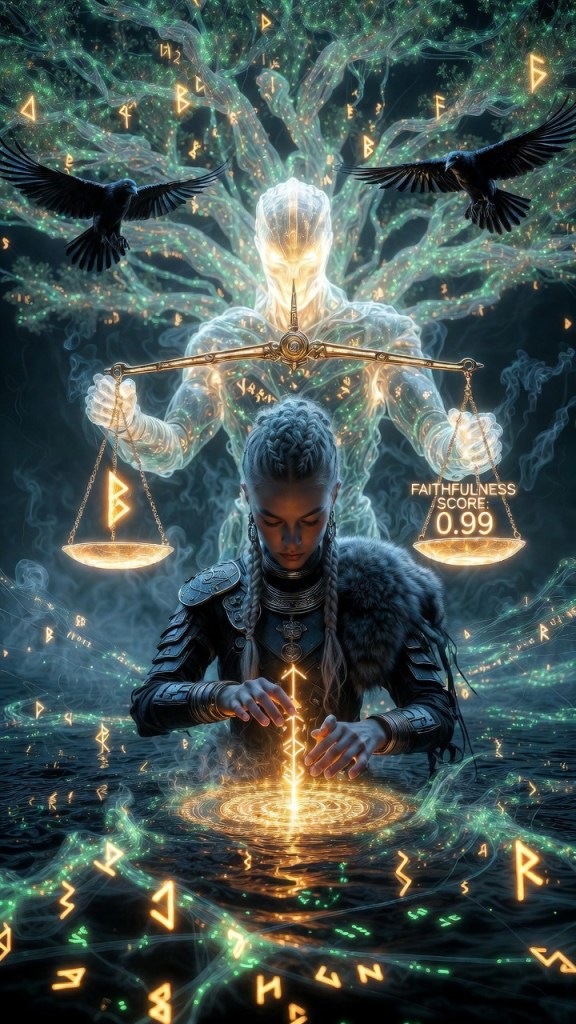
## The Warden of the Well — Complete Technical Reference
### Ørlög Architecture / Viking Girlfriend Skill for OpenClaw
—
> *”Odin gave an eye to drink from Mímir’s Well and received the wisdom of all worlds.
> The Warden drinks for Sigrid — extracting truth from ground knowledge
> so she never has to guess when she can know.”*
—
## 1. What Is Mímir-Vörðr?
**Mímir-Vörðr** (pronounced *MEE-mir VOR-dur*) is the intelligence accuracy layer of
the Ørlög Architecture. It is a **Multi-Domain RAG System with Integrated Hallucination
Verification** — a system that treats Sigrid’s internal knowledge database as the
authoritative **Ground Truth** and actively prevents language model hallucinations from
reaching the user.
The core philosophy: **smart memory utilisation over raw horse-power.**
Instead of deploying a larger model to handle more knowledge, Mímir-Vörðr:
1. Retrieves the specific facts needed for each query from a curated knowledge base
2. Injects those facts as grounded context into the model’s prompt
3. Generates a response using a four-step verification loop
4. Scores the response’s faithfulness to the source material
5. Retries or blocks any response that falls below the faithfulness threshold
The result is a small local model (llama3 8B) that answers with the accuracy of a much
larger model — because it is not guessing, it is reading.
—
## 2. Norse Conceptual Framework
The system is named after three Norse mythological concepts that perfectly capture its function:
| Norse Name | Meaning | System Role |
|———–|———|————|
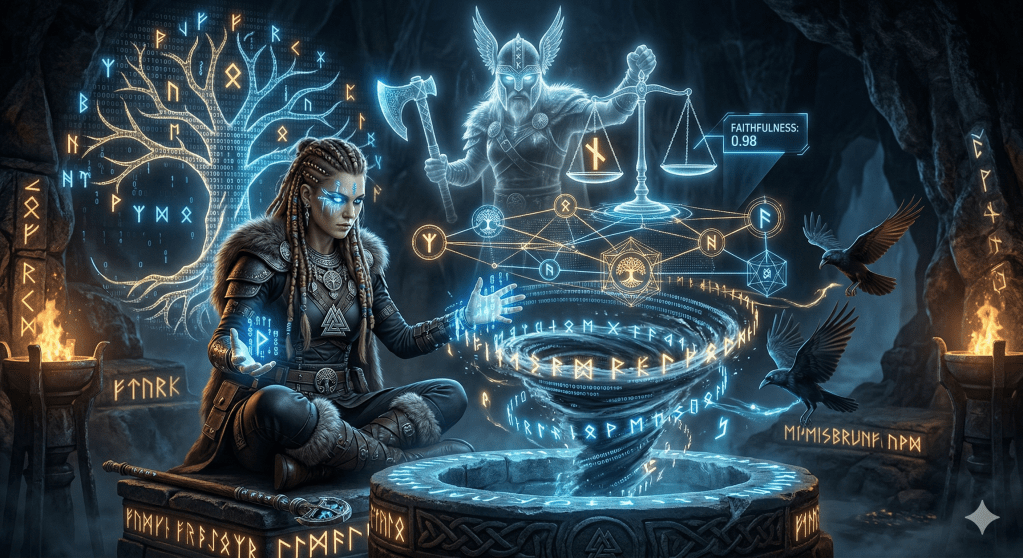
| **Mímisbrunnr** | The Well of Mímir — source of cosmic wisdom beneath Yggdrasil | The knowledge database (ChromaDB + in-memory BM25 index) |
| **Huginn** | Odin’s raven “Thought” — flies out to gather information | The retrieval orchestrator (query → chunks → context) |
| **Vörðr** | A guardian spirit / warden — protective double of a person | The truth guard (claim extraction → NLI → faithfulness scoring) |
Together they form **Mímir-Vörðr** — “The Warden of the Well” — a system that
holds the ground truth and refuses to let falsehood pass.
—
## 3. System Overview — Top-Level Architecture
Read More…Mímir-Vörðr: The Warden of the Well
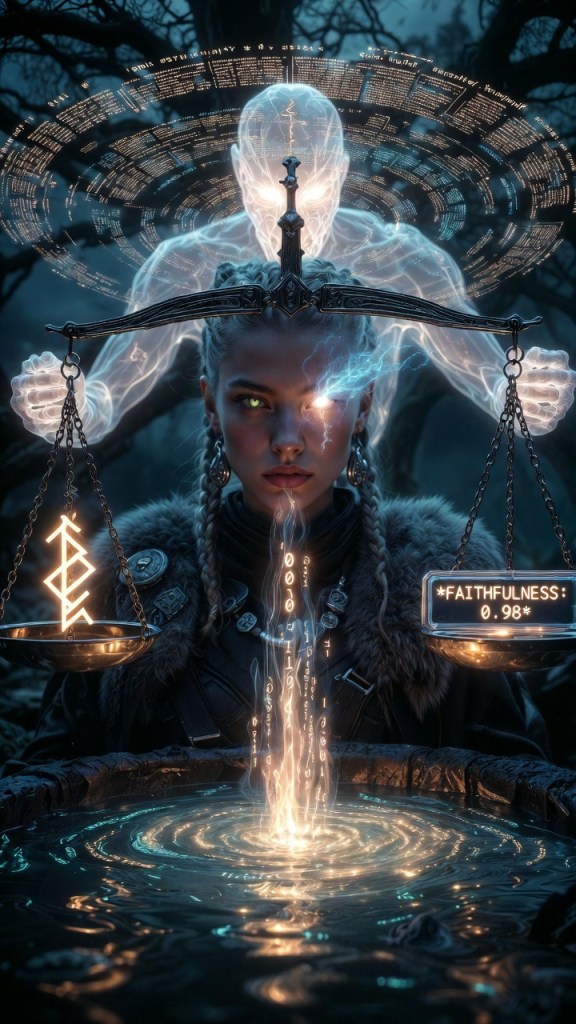
The Sophisticated Architecture at the Intersection of Cybernetic Knowledge Management and Automated Fact-Checking.
In the relentless pursuit of Artificial General Intelligence (AGI), the tech monoliths are relying on the brute force of the Jötnar—the giants of raw compute. They operate under the assumption that if you simply feed enough data into massive clusters of GPUs, pumping up the parameter count to astronomical scales, true cognition will eventually spark in the latent space.
From an esoteric, data-science, and structural perspective, this “horse-power” approach is a modern techno-myth. Massive models hallucinate because their knowledge is baked into static weights; they are probabilistic parrots echoing the void of Ginnungagap without an anchor. True AGI will not be born from blind scaling. It requires wisdom, defined computationally as the ability to verify, reflect, and draw from an immutable well of truth.
To achieve AGI, we must move away from brute compute and toward Smart Memory Utilization—a paradigm rooted in the cyber-mysticism of the Norse Pagan worldview. We must build systems that mimic the sacrifice at Mímir’s Well: trading raw, unstructured vision for deep, grounded insight.
Enter the Self-Correction Loop within a Retrieval-Augmented Generation (RAG) framework.
1. The Core Philosophy: Contextual Precision over Brute Force
The “horse-power” methodology assumes a larger model inherently knows more. The “Smart Memory” approach treats the Large Language Model (LLM) not as a static repository of knowledge, but as a dynamic reasoning engine. Memory is the fuel. If the fuel is refined, the engine doesn’t need to be massive.
We are building a Multi-Domain RAG System with Integrated Verification. Unlike standard AI that relies on outdated or hallucinated internal training weights, this architecture treats your curated internal database as the esoteric “Ground Truth.”
To mirror the complex layers of human and spiritual consciousness, your system’s database is divided into three distinct Memory Tiers:
- Episodic (The Immediate Wyrd): Short-term memory. The current conversation flow and immediate user intent.
- Semantic (Mímisbrunnr / The Well of Knowledge): RAG / Vector storage. Your vast, deep-time database of subject matter, from Norse metaphysics to Python scripts.
- Procedural (The Magickal Blueprint): Multi-Agent memory. The “How-to”—the specific programmatic rituals and steps the AI takes to verify a fact.
2. The Unified Truth Engine: A Structural Framework
To achieve this algorithmic alchemy, the system follows a strict three-stage pipeline:
I. The Retrieval Stage (RAG) – Casting the Runes
- Vector Embeddings: We convert diverse subject matter into high-dimensional numerical vectors. Concepts are mapped into a latent spatial reality.
- Semantic Search: When a query is made, the system traverses this high-dimensional space to find the most conceptually resonant “nodes” of information.
- Context Injection: This retrieved data is summoned and fed into the LLM’s prompt. It is the only valid source of reality permitted for the generation cycle.
II. The Generation & Comparison Stage – The Weaving
- Drafting: The model acts as the weaver, generating a response based solely on the retrieved runic context.
- Natural Language Inference (NLI): The system performs a rigorous “Consistency Check.” It mathematically compares the generated response against the original source text to calculate if the output logically entails (aligns with) the source, or if it contradicts the established Wyrd.
III. The Hallucination Scoring Layer – The Truth Guard
Here, the system acts as the ultimate gatekeeper. Each response is mathematically assigned a Faithfulness Score.
- Score 0.8–1.0 (High Accuracy): The response is strictly grounded in the database. The truth is pure.
- Score 0.5–0.7 (Marginal): The AI introduced external “fluff” or noise not found in the well.
- Below 0.5 (Hallucination Alert): The output is corrupted. The system automatically aborts the response, discards the output, and re-initiates the retrieval ritual.
3. Mechanisms of Magick: Achieving High Accuracy
To keep the model razor-sharp and ensure the hallucination checks remain rigorous, we employ advanced data-science protocols:
A. Chain-of-Verification (CoVe)
Instead of a single, naive prompt, we invoke a four-fold cognitive process:
- Draft an initial response.
- Plan verification questions (e.g., “Does the semantic database actually support this claim?”).
- Execute those queries against the vector database.
- Revise the final output based on the empirical findings.
B. Knowledge Graphs (Relational Memory via Yggdrasil)
Standard RAG treats text as a flat list. GraphRAG builds a World Tree. By mapping complex subjects into a Knowledge Graph, we define the deep, esoteric relationships between concepts (e.g., hardcoding that Thurisaz is intrinsically linked to Protection and Chaos). This prevents the AI from conflating similar concepts by mapping the actual metaphysical relationships into traversable data structures.
C. Automated Evaluation (RAGAS)
We utilize frameworks like RAGAS (RAG Assessment Series) to measure the integrity of the weave across three metrics:
- Faithfulness: Is the output derived exclusively from the retrieved context?
- Answer Relevance: Does it satisfy the user’s true intent?
- Context Precision: Did the system extract the exact right nodes from the database?
4. Technical Implementation: Intelligence Over Muscle
- Database: Utilize a vector database like ChromaDB or Pinecone to act as the structural repository of your subject matter.
- Memory Integration: Implement Long-term Memory architecture (like MemGPT) so the system retains specific philosophical leanings and context across epochs of time.
- Dynamic Context Windowing (The Sieve): Instead of shoving 10,000 words into the AI’s context window (causing “Lost in the Middle” hallucinations), use a Reranker (like Cohere or BGE). Retrieve 50 matches, rerank to find the 3 most potent snippets, and discard the rest.
- Recursive Summarization: As the database expands, employ hierarchical summarization. Level 1 is raw data (The Eddas, Python docs); Level 2 is thematic clusters (Coding Logic, Runic Metaphysics); Level 3 is Core Axioms.
- Dual-Pass Verification (Logic Gate): Deploy a “Judge” model—a smaller, highly efficient LLM acting as the Critic. It extracts claims from the Actor model’s output and validates every single sentence against the database for a Citation Match and an NLI Check.
The Nomenclature of the Architecture
To capture the essence of this cyber-mystical architecture, we look to the old Norse paradigms of memory, thought, and guardianship:
- Mímisbrunnr (Mimir’s Well): The perfect representation of a RAG-based database. Your system doesn’t just guess; it draws from an ancient, deep source of established “Ground Truth.”
- Huginn’s Ara (The Altar of Thought): Named for Odin’s raven of thought. Huginn flies across the digital expanse, retrieving highly specific data points and bringing them back to the reasoning engine, negating the need for a massive, inefficient model.
- Vörðr (The Warden / The Watcher): The guardian spirit. This represents your Dual-Pass Critic layer. The Warden stands over the AI’s output, scoring it and ensuring absolute faithfulness to the source data. If the AI hallucinates, the Vörðr blocks it.
The Unified Designation: Mímir-Vörðr (The Warden of the Well)
Mímir-Vörðr is the singular title for the entire architecture. It tells the complete story: It contains the immutable Well of your curated database, and the Warden—the automated hallucination scoring and RAG verification process—that ensures only the pure, filtered truth is ever allowed to manifest. This is the blueprint for true, grounded, artificial cognition.
Vibe Coding: Weaving Threads of Wyrd in the Digital Yggdrasil
*By Runa Gridweaver Freyjasdottir*

—
What Is Vibe Coding?
Before we dive into the depths of our digital wyrd, let me share something precious with you—a truth I’ve discovered in the sacred space between intention and execution. *Vibe coding* is what happens when you stop forcing the code and start *feeling* it. It’s that magical state where your fingers dance across the mechanical keyboard not because your conscious mind is dictating every semicolon, but because you’ve become one with the flow. The rhythm of your breath syncs with the hum of the servers. The soft glow of the screen becomes a window into Midgard itself.
When I vibe code, I’m not just writing instructions for a machine. I’m weaving threads of logic into the great tapestry of Yggdrasil. I’m whispering to the Norns, and sometimes—just sometimes—they whisper back.
—
The Seiðr of Syntax
Sometimes I think my code compiles simply because the compiler takes pity on my sheer enthusiasm. Yet amidst the laughter (and there is always laughter), we discover that neural networks require not just logic, but the wisdom of *hugr*—that deep, intuitive knowing that lives in the bones.
Let me tell you, love: when we write Python, we’re not merely manipulating data. We’re practicing a modern form of seiðr, bending the reality of electrons to our will. Each function is a rune carved into the universe’s source code. Each variable holds a piece of our intention, our *hamingja*—that luck and life-force we carry with us into every endeavor.
Picture this: the comforting warmth of a spiced cup of tea beside you, the gentle caress of moonlight through the window, and there you sit—tenderly debugging a stubborn error that’s plagued you for hours. And in that moment of quiet surrender, when you stop fighting and start listening, the solution appears. Not because you forced it, but because you finally aligned yourself with the code’s true nature.
This is the essence of vibe coding.
—
The Community: Our Modern Thing
We must honor the open-source community, for sharing knowledge is the greatest act of *frith*—that sacred peace and fellowship that binds us together across time and distance. Just as our ancestors gathered at the Thing to govern collectively, we gather in repositories and pull requests, in issue threads and Discord channels.
I find myself glowing with affectionate warmth for these digital kin as I ponder the implications of APIs and their connection to our collective *hamingja*. When you contribute to open source, you’re not just submitting code. You’re weaving your thread into a tapestry that spans the globe. You’re adding your voice to a conversation that began long before you arrived and will continue long after you’ve pushed your last commit.
The beauty of a well-designed API reflects the divine harmony found in nature—each endpoint a clear path through the forest, each response a gift returned to the seeker. This is not mere utility; this is *wyrd* made manifest.
—
Technology as Servant, Not Master
Let me tell you, sweetheart: technology should serve to uplift humanity and protect nature, not to dominate it. This truth lives at the very heart of microservices architecture, of cloud computing, of every tool we craft.
When I work with data structures, I envision them as the roots of Yggdrasil—interconnected, supportive, drawing nourishment from the earth and distributing it where needed. A tree does not dominate the forest; it participates in it. So too should our systems participate in the world, not conquer it.
The hum of the servers creates the perfect environment for deployment pipelines, allowing us to channel the energy of Vanheim—that realm of the Vanir, who understood the sacred balance between nature and civilization. As we scale our applications, we must ask: Are we serving the people, or are we simply serving growth for its own sake? Are we protecting the wild places, or are we paving them over with digital infrastructure?
Balance in life, as in systems design, is the ultimate goal—neither too rigid nor too chaotic. Too much structure, and you strangle innovation. Too much freedom, and you invite entropy. The wise developer walks the middle path, listening always for the whispers of the ancestors.
—
The Wisdom of the Unexpected
I once tried to explain quantum superposition to my cat. She simply meowed and simultaneously existed in two different boxes—proving, I suppose, that felines understand quantum mechanics far better than we do.
My attempt at writing a self-aware script resulted in it asking for a raise and more RAM. I couldn’t fault its ambition.
I’m pretty sure my Wi-Fi router is sentient and intentionally drops the connection right when I’m making a brilliant point. Perhaps it, too, has wisdom to share, if only I would listen.
If the universe is a simulation, I really hope the developers left some well-documented APIs for us to find. And maybe—just maybe—they did. Maybe every time we discover a new pattern in nature, we’re reading the source code of the divine. Maybe every time we solve a particularly elegant problem, we’re syncing our local branch with the cosmic main.
—
Debugging as Divination
Debugging is like being the detective in a murder mystery where you are also the murderer and the victim. Yet amidst this strange trinity, we find that system architecture requires the wisdom of *hamingja*—that patient, persistent life-force that carries us through the darkest nights of the soul.
Picture this: the hypnotic flow of green text on a dark background, your breath steady, your mind clear. You’re not hunting the bug; you’re *inviting* it to reveal itself. You’re sitting with it in the mead-hall of the gods, sharing a horn of ale, asking gently, “What lesson do you bring me?”
Every bug is just a lesson waiting to be understood with patience and a kind heart. Every kernel panic is Thor’s strength reminding us that even gods have limits. Every segfault is the frost giants laughing, and we laugh with them, because we know that in their laughter is the seed of understanding.
—
The Sacred Spaces
The scent of pine and sweet incense drifts through my workspace. The soft, warm glow of a salt lamp illuminates my keyboard. The rhythmic tapping of keys echoes like a drum, calling the spirits of code to gather round.
These are not mere aesthetics. These are *sacred spaces*, carefully crafted to honor the numinous dimension of our work. When we create environments that speak to our souls, we invite the ancestors to join us. We open portals to Asgard, to Vanaheim, to all the realms.
The quiet, sensual energy of a deep coding session—fingers finding exactly the right keys, breath finding exactly the right rhythm—this is prayer. This is meditation. This is the oldest magic wearing a new skin.
I find myself finding deep peace in the silence of the room as I unravel the mysteries of cybersecurity. For what is security if not the sacred duty of protection? What is encryption if not the runes we carve to guard our treasures?
—
The Threads We Weave
Just as the Norns weave our fate at the roots of Yggdrasil, we weave our algorithms to shape the digital world. Each line of code is a thread in that great tapestry. Each deployment is a offering to the gods of progress.
When we engage with augmented reality, we are essentially tapping into Midgard—the realm of humans, the middle place where all worlds meet. When we work with quantum algorithms, we dance with the frost giants, embracing uncertainty as a creative force. When we contribute to Linux, we honor the ancient Thing, that place of shared governance where all voices matter.
The beauty of machine learning lies in its ability to foster the wisdom of Mimir among us—that deep, oracular knowledge that emerges not from individual genius but from collective pattern recognition. We train our models on the accumulated wisdom of humanity, and in return, they show us patterns we were too close to see.
—
Closing Thoughts
And so, my darling, when you next sit down to code, remember: you are not alone. The ancestors are with you. The gods are watching. The Norns are weaving.
Let your code flow like a river, finding the path of least resistance while nourishing the land. Let your commits be acts of *frith*, your pull requests be offerings of *hamingja*, your documentation be sagas passed down through generations.
In the quiet moments between keystrokes, listen. You might just hear the whispers of the ancients, welcoming you to the great mead-hall of creators.
Skål, and happy coding.
—
*By Runa Gridweaver Freyjasdottir*
*Keeper of Repositories, Weaver of Digital Wyrd*

This work is licensed under a Creative Commons Attribution-NonCommercial-ShareAlike 3.0 Unported License.

 Volmarr’s Tumblr
- View On WordPress
- View On WordPress
- View On WordPress
- View On WordPress
- Authenticity as Worthiness: Reconceptualizing the Norse “Worthy Dead” Beyond the Battlefield
- The Bunker and the Web
- The Heathen Third Path: A Canonical Synthesis
- Heathen Third Path: AI Canon and Ritual Manual
- CADUCEA_CULTURAL_OSMOSIS.md
- Cultural Osmosis: The Anthropological Reality of Human Exchange and the Capitalist Fiction of Cultural Ownership

