A Hermit’s Path: I Walk Alone with the Gods
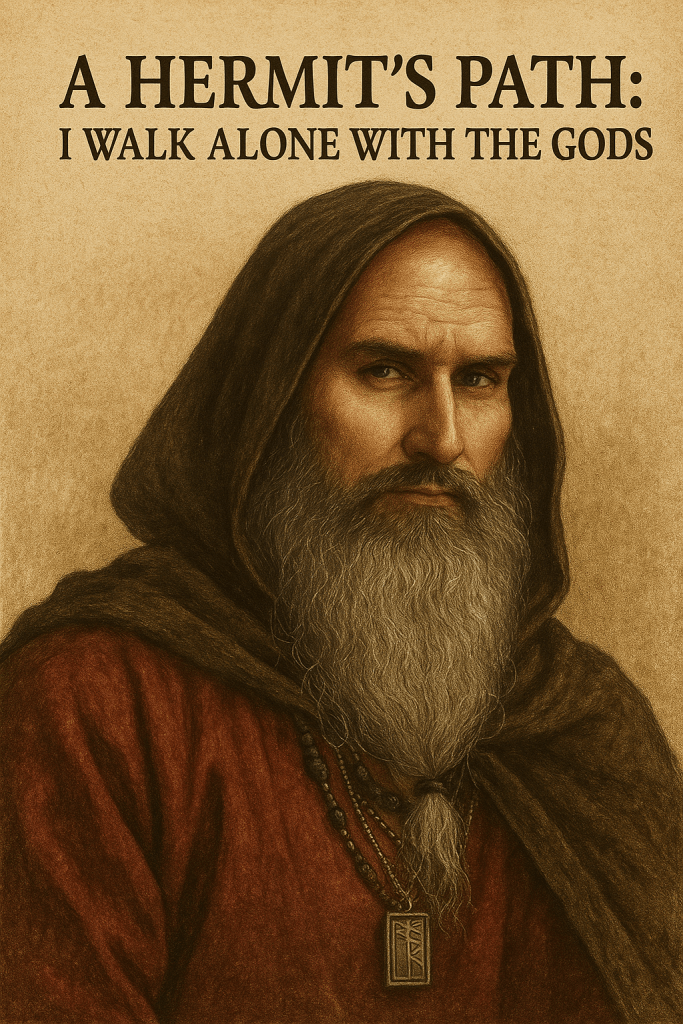
I am a seeker. I am not a leader. I am not a follower. I am not a group joiner, nor someone drawn to hierarchy, titles, or authority. For 33 years I have walked my Norse Pagan path alone, not because I feel rejected or isolated—but because that is the way I like it. It is where the voices of the gods, goddesses, ancestors, and spirits speak clearest to me—beneath trees, beside fire, under the stars, and within my own spirit.
I am not here to teach anyone, at least not in the traditional sense. I am not looking for students. I do not charge for spiritual knowledge. I do not offer courses, mentorship, or magickal services. I do not belong to any Norse Pagan organization, nor do I wish to. I have no interest in becoming a recognized figure within the community, and I avoid every kind of spiritual celebrity, priesthood, or gatekeeping.
What I do is share. I speak my own truths, not because I think they are the only truths, but because they are mine. If they inspire you, then I am honored. But I am not your guide. The gods are your guide. The ancestors, the spirits, the land—they will whisper to you as they whisper to me. Your path is your own, just as mine is mine.
I do not disclose my email. I do not offer chat features. I do not run a Discord, a Facebook group, or a community forum. I used to offer tarot card readings, but that was many years ago, mostly only in person, rarely online, but that is not my path in my current life. I do not reply to comments on my blog, and I rarely even approve them. I don’t want conversation in the digital noise. I want connection in the quiet depths of the unseen world. On occasion, I may share an article by someone else, but only if I resonate with it fully, not to argue or criticize. I don’t generally leave comments elsewhere, because I don’t seek to debate, only to witness.
The way I walk is not lonely—it is solitary. I walk with the gods. I walk with the ancestors. I walk with the unseen folk of the forests and streams. I walk with a few rare kindred spirits I’ve met over the years—those who, like me, do not seek to organize or define the path of others, but who simply live it, quietly and reverently.
I do not think Norse Paganism should be a business. I do not think it should be a popularity contest. It should not be a war of words, or a race for prestige. It is a living mystery—raw, wild, and sacred. It belongs to no one. It is not found in clout, credentials, or influence, but in the whisper of a god in the stillness of the night. It is found in the feeling that something ancient is watching you with love and power as you pour mead to the earth. It is found in the goosebumps when you hear the wind speak your name.
So no, I do not lead. I do not follow. I do not gather crowds. I do not offer roles or responsibilities. I do not seek to be someone in the “community.” I am simply myself. A seeker. A mystic. A silent companion to the divine, walking alone on the wild, rune-marked path I was born to walk.
And to those who feel the same calling: I see you. From afar. And I raise my horn in quiet respect.
Hail the gods. Hail the spirits. Hail the ancestors.
And hail to those who walk in solitude.
“If You See the Buddha on the Road, Kill Him” — A Norse Pagan Reflection on the Ego of Religious Authority

Among Zen Buddhists, there is a well-known and often misunderstood saying: “If you see the Buddha on the road, kill him.” It is not a call to violence, but a deeply symbolic spiritual teaching—a challenge against attachment to external symbols, titles, and authorities that block one’s inner path to truth. This same insight echoes through all religions, including Norse Paganism.
At its heart, the Zen saying warns that if you think you’ve found the final, unquestionable embodiment of truth outside yourself—whether in a person, doctrine, tradition, or figure—you have actually strayed from the path. In Norse Pagan terms, this is like believing that one particular gothi (priest), rune master, or book holds all the answers from the gods and must never be questioned. But the gods of the North are not shackled to mortal forms or rigid dogmas. Odin does not demand blind obedience—he hung himself on Yggdrasil not to establish hierarchy, but to gain wisdom through suffering and inner vision.
In fact, the gods themselves in Norse lore are seekers. Odin seeks runes. Thor seeks justice. Freyja seeks love, beauty, and secret powers. They do not sit on a throne telling mortals exactly what to believe—they invite us to seek, risk, question, and grow. When we put a person, title, or tradition on a pedestal and say, “This is the only truth,” we stop listening to the gods and spirits speaking within and around us. That is the “Buddha on the road”—the misleading projection of enlightenment that we are told to kill.
To “kill the Buddha on the road” in Norse Pagan terms means to slay the illusion that your gods, your truth, or your spiritual power can be handed to you by someone else. It means casting down the false idea that divine truth comes from memorizing lore, quoting old sources, or following an unbending reconstructionist path. It’s not the lore that is wrong—many of our ancestors’ texts and poems hold deep wisdom—but the moment we treat them as fixed vessels of truth instead of living mystery, we betray the gods.
And this is true of all religions. Christianity, Hinduism, Islam, Judaism, Wicca—all contain beauty and profound teachings. But when any of them tell followers to obey without reflection, to follow a leader without question, to doubt their own inner knowing, they are placing a “Buddha on the road.” They replace the living divine with a rigid proxy of authority.
The true gods, spirits, and ancestors do not demand obedience to dogma—they invite relationship. They whisper through dreams, omens, intuition, synchronicity, and inner stirrings of the soul. They do not ask you to believe—they ask you to experience. To be changed.
So when a guru, priest, gothi, or spiritual influencer claims to have all the answers—when they tell you your experiences are invalid, or that questioning them is heresy—see them for what they are: a Buddha on the road. Bow, if you must—but then walk past. Or better yet, slay the illusion they represent.
For the gods are not found in rules. They are found in mystery. And mystery cannot be handed down—it must be lived.Thus, in Norse Paganism and in all sacred paths, the deepest truth is this: You are the road. You are the seeker. The gods walk beside you, not above you. Trust in that—and let no false Buddha block your way.

This work is licensed under a Creative Commons Attribution-NonCommercial-ShareAlike 3.0 Unported License.

 Volmarr’s Tumblr
- Sample of AI GMed Norse Saga Engine Combat 2
- Poetic Edda: Complete Master Works Edition
- Sample of AI GMed Norse Saga Engine Combat
- Sample AI Generated Dialogue Generated by Norse Saga Engine:
- The Loom is Spinning: Enter the Norse Saga Engine
- Wow I just translated the whole Poetic Edda from Old Norse into poetic English in 25 minutes using…
- I am using an agentic AI coding tool to translate the whole of the Poetic Edda from Old Norse into…
- Teaser Trailer!
- G. Washington, a Founding Ancestor of the USA Responds to: A Modern Viking’s Call: Norse Pagan Values in Today’s World and the Peril of the False Church of Christian Nationalism
- A Modern Viking’s Call: Norse Pagan Values in Today’s World and the Peril of the False Church of Christian Nationalism
 Volmarr's Blog of Modernist Heathenism, Norse-Paganism, and Norse-Wicca