Why Strict Reconstructionist Norse Paganism Is Roleplay—Not a Living Spiritual Practice for Most
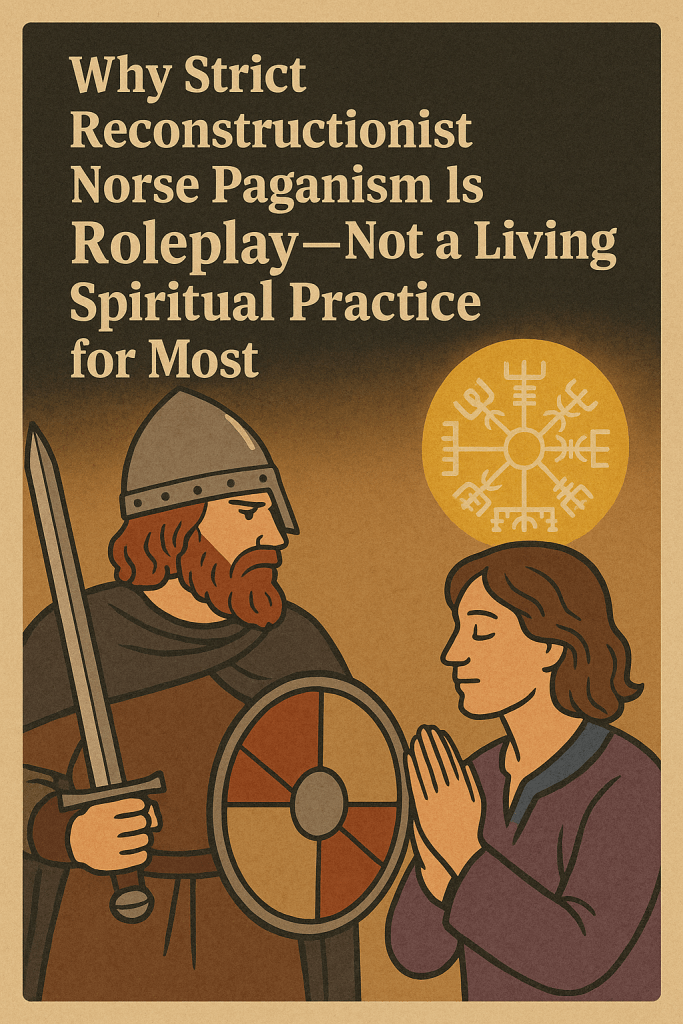
In the world of Norse Paganism, there’s a growing tension between two very different approaches: strict reconstructionism and modern spiritual adoption. At first glance, both claim to honor the gods and revive ancient ways—but scratch the surface, and their core intentions begin to sharply diverge.
Strict reconstructionists attempt to practice Norse Paganism as close as possible to how it was performed over a thousand years ago. Their goals are often academic and historical in nature—following archaeological records, scholarly interpretations, and surviving lore as strictly as possible. From the type of mead poured in ritual to the precise reconstruction of Iron Age clothing or burial rites, the focus is often on reenacting history with accuracy. In truth, this approach has more in common with living history roleplay than with a living, breathing, evolving spiritual path.
And that’s not inherently a bad thing. Some people do connect deeply with the spiritual dimension through historical reenactment. For them, reconstructing ancient rituals and customs may feel reverent and grounding. But it’s important to acknowledge that this is not the only, nor the most accessible, way to walk a spiritual path rooted in the Norse tradition.
Reconstructionism as Spiritual Roleplay
Let’s be clear—roleplay is not an insult. It is a legitimate form of expression. Historical reenactors often feel transformed when donning the clothes and manners of a bygone time. But that transformation is often theatrical and symbolic, not existential. The strictest forms of Norse Pagan reconstructionism fall into this category. They aren’t really meant to function as a religious practice that addresses modern human needs—emotional healing, personal growth, mystical connection, or guidance through trauma, anxiety, or love. They’re meant to recreate the past as closely as possible. In this, they function more like immersive theater or participatory anthropology.
To the average person seeking spiritual depth, comfort, insight, or healing, this “museum exhibit” approach offers little. It risks becoming a cage of historical fetishism, where one’s personal gnosis is dismissed because it didn’t come from a 13th-century Icelandic manuscript. This strict gatekeeping often stifles the organic, transformative nature of religion, which has always adapted to new cultural contexts throughout history.
The Need for a Living Spiritual Practice
Living spirituality is not frozen in time. It grows with the people who walk it. Modern Norse Paganism must be allowed to breathe—to evolve in the hearts of those who embrace it, integrating the ancient with the modern, the mythic with the mystical, and the historic with the intuitive. After all, the gods themselves are not dead cultural relics. They are living autonomous spiritual beings, beings of great power, meaning, and presence that people can still feel, dream of, and be transformed by today.
The modern world brings different needs than the Viking Age. We wrestle with urban alienation, ecological collapse, neurodivergence, spiritual longing in an age of disconnection, and a search for meaning beyond corporate modernity. We don’t need a historically perfect blot in a longhouse to find sacredness—we need connection, authenticity, and soul-level truth.
A living Norse Pagan practice honors the spirit of the old ways without being enslaved to their letter. It welcomes offerings from today’s world: meditation, trancework, modern rituals, cross-cultural influences, even VR temple spaces or AI rune readings—if they bring the seeker closer to the divine. It dares to believe that Odin, Freyja, and the spirits of the land are not frozen in the Viking Age, but walk beside us now, adapting with us.
There’s Room for Both—But Let’s Be Honest About What They Are
There is nothing wrong with practicing Norse Paganism as living-history roleplay. It can be fun, educational, and even meaningful. But it should not be confused with a universal path to spiritual transformation. Most people today are not looking for perfect historical reenactment—they are looking for purpose, power, belonging, and divine connection. That calls for something alive, not just accurate.
In the end, both paths—strict reconstruction and adaptive spirituality—have their place. But for the majority of spiritual seekers, the gods do not demand authenticity to the 10th century. They ask for sincerity of the heart, integrity of intent, and the courage to meet them here and now, in the sacred space of this age.

This work is licensed under a Creative Commons Attribution-NonCommercial-ShareAlike 3.0 Unported License.

 Volmarr’s Tumblr
- View On WordPress
- The Personal Norse Pagan Path That I, Volmarr, Follow.
- The Heathen Third Path within Norse Paganism and modern Viking culture
- Unveiling the True Viking Mindset: Clearing Away Modern Political Shadows with Ancient Wisdom and Modern Science
- Sample of AI GMed Norse Saga Engine Combat 2
- Poetic Edda: Complete Master Works Edition
- Sample of AI GMed Norse Saga Engine Combat
- Sample AI Generated Dialogue Generated by Norse Saga Engine:
- The Loom is Spinning: Enter the Norse Saga Engine
- Wow I just translated the whole Poetic Edda from Old Norse into poetic English in 25 minutes using…
 Volmarr's Blog of Modernist Heathenism, Norse-Paganism, and Norse-Wicca