What is Christatrú?
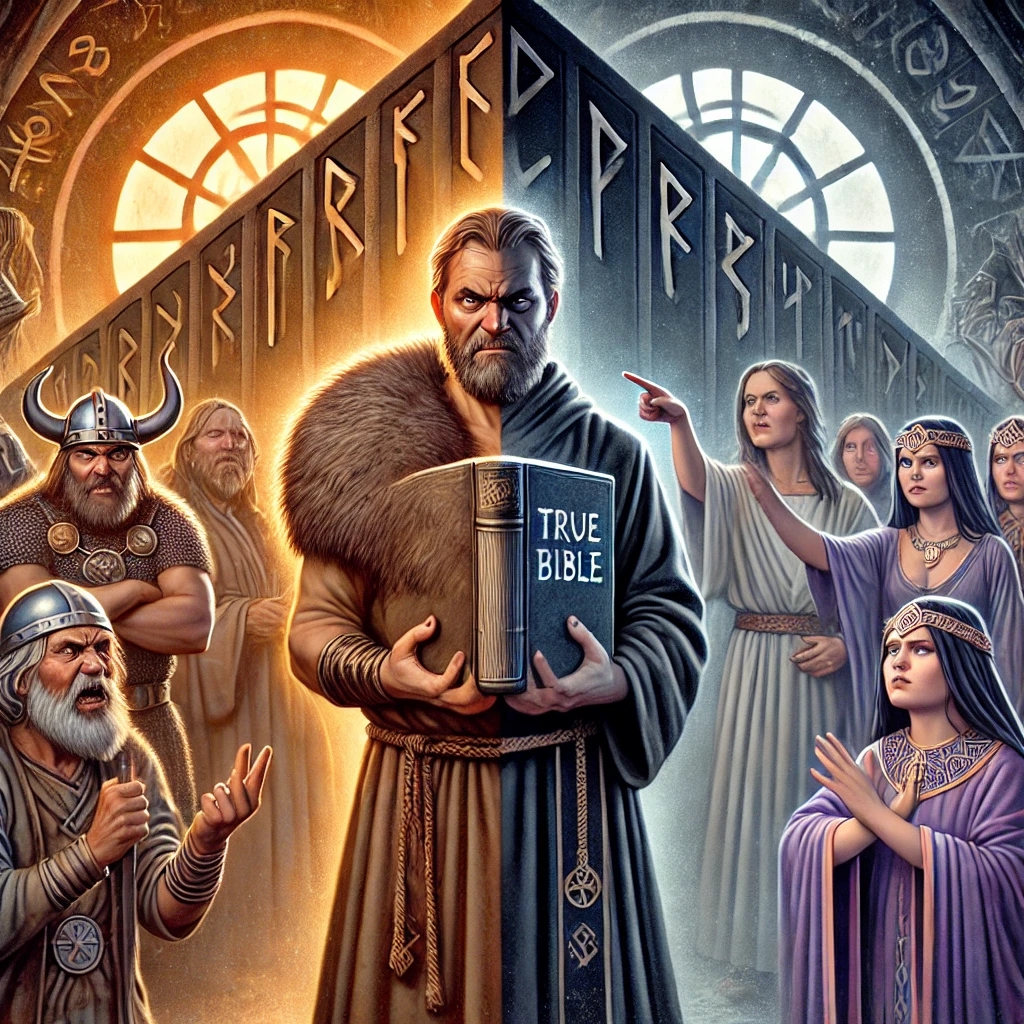
Christatrú is a term used to describe individuals who claim to practice Norse Paganism (often under the label of Ásatrú) but whose mindset, behaviors, and beliefs remain fundamentally Christian in nature. Despite outwardly adopting Norse gods and traditions, Christatrúar retain a monotheistic, dogmatic, and moralizing approach to spirituality, making them a poor fit for true Norse Paganism. Their worldview is often shaped by Christian-influenced concepts of morality, authority, and universal truth, which are alien to pre-Christian Norse religious perspectives.
Core Behaviors and Viewpoints of Christatrúar
Christatrúar can be identified by specific behaviors, attitudes, and viewpoints that contradict the core nature of Norse Paganism. These include:
1. Monotheistic Mindset in Polytheistic Disguise
- Christatrúar may worship multiple gods in name but still treat one deity (usually Odin or Thor) as an all-powerful, supreme god in a way that mirrors Christian monotheism.
- They seek absolute truth and rigid dogma instead of embracing the decentralized, diverse, and experience-based spirituality that defines polytheistic traditions.
- They are uncomfortable with the idea that different people might have different relationships with the gods or that UPG (Unverified Personal Gnosis) is valid.
2. Lore-Thumping and Biblical Thinking
- They treat the Poetic and Prose Eddas as “holy scripture”, refusing to acknowledge that these were medieval Christian-influenced retellings of an oral tradition.
- Christatrúar reject personal and mystical experiences unless they can be proven in the lore, essentially mimicking Biblical literalism.
- They believe there is a “correct” way to practice Norse Paganism, mirroring the Christian emphasis on doctrine, orthodoxy, and heresy.
3. Moral Absolutism and Christianized Ethics
- They apply Christian-influenced moral frameworks to Norse Paganism, expecting the gods to be moral authorities rather than powerful forces of nature with their own agendas.
- Concepts like “good vs. evil,” sin, and purity—foreign to ancient Norse culture—are reintroduced into Norse Pagan spaces.
- They insist that some gods, such as Loki or Hel, are “evil,” an interpretation heavily influenced by Christian dualism.
4. Religious Intolerance and Gatekeeping
- Christatrúar often attempt to police and control others’ beliefs, calling anything outside of their strict interpretation “wrong” or “fake.”
- They reject eclectic spirituality, condemning those who incorporate runes, seiðr, animism, shamanism, or personal gnosis if it doesn’t fit their rigid view.
- They react to disagreement with authoritarianism, trying to impose rules rather than allowing spiritual growth through experience.
5. Seeking Divine Validation Over Reciprocity
- Christatrúar expect the gods to validate, love, or “save” them, akin to Christian expectations of divine grace.
- True Norse Paganism operates on a model of reciprocity (do ut des – “I give so that you may give”), where worship is an exchange, not an entitlement.
- They may act as though the gods owe them guidance, protection, or special treatment just because they worship them.
6. Christian-Modeled Community Structures
- They attempt to organize Norse Paganism like a church, centralizing power and authority around a singular interpretation or group.
- Some even form priesthood hierarchies reminiscent of Christian clergy, which is inconsistent with the decentralized nature of pre-Christian Norse religion.
- They expect followers to conform to an orthodox “community standard”, punishing those who don’t.
7. Fear of Magic, Mysticism, and Feminine Spirituality
- They reject or downplay seiðr, divination, and magic, often associating them with Christian taboos.
- Some adopt an ultra-masculine, warrior-only perspective that dismisses the spiritual and mystical side of Norse traditions, ignoring figures like the Völva (seeress) who were essential to Norse religious practices.
- They fear “New Age” influences, despite Norse Paganism being an evolving, living spiritual path.
Why Christatrúar Attitudes Should Not Be Considered Part of Norse Paganism
Christatrú is not a form of Norse Paganism—it is monotheistic Christianity wearing a Pagan mask. The attitudes and behaviors listed above contradict the fundamental characteristics of true Norse spirituality:
- Polytheism & Animism – True Norse Paganism embraces the diversity of the gods, wights, and spirits, without enforcing hierarchical control over them.
- Fluidity & Personal Experience – There is no “one right way” to practice; different tribes and individuals had unique relationships with the gods.
- Reciprocity Over Submission – Worship is an exchange, not an act of submission to a supreme deity.
- No Rigid Dogma – The Norse didn’t have a sacred text or priests controlling religious law.
- Acceptance of Fate & Mystery – The ancient Norse embraced the unknown, rather than demanding theological certainty.
Christatrúar fail to embody these principles, making their worldview incompatible with genuine Norse Paganism. Allowing their attitudes to persist in Pagan spaces undermines the core spirit of the faith, replacing it with the very same authoritarian dogma that pre-Christian peoples rejected.
Final Thought: True Norse Paganism Stands Apart
Norse Paganism should not be a replacement church for disillusioned Christians who refuse to let go of their old ways of thinking. Those who wish to bring Christian attitudes into Norse Paganism should instead confront their ingrained monotheistic worldview and deconstruct it, rather than attempting to mold Norse spirituality into something it was never meant to be.
To truly embrace the old ways, one must unlearn the chains of monotheistic absolutism and rediscover the free, complex, and deeply personal connection that our ancestors had with the gods.

This work is licensed under a Creative Commons Attribution-NonCommercial-ShareAlike 3.0 Unported License.


 Volmarr's Blog of Modernist Heathenism, Norse-Paganism, and Norse-Wicca